

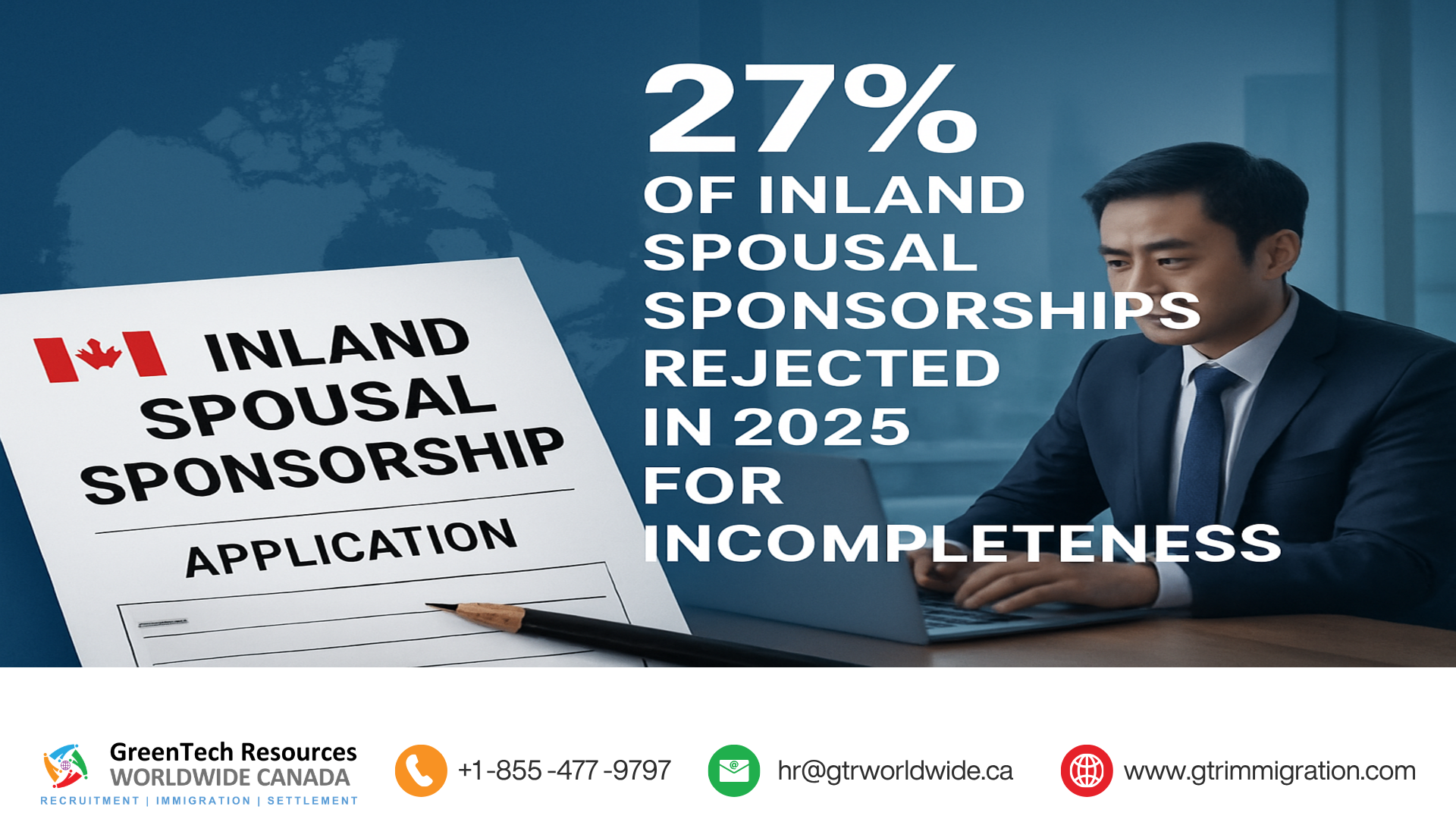
27% of Inland Spousal Sponsorships Rejected in 2025 for Incompleteness
Refused Inland Spousal Sponsorships: Why 27% of 2025 Applications Failed the R10 Completeness Check and How to Avoid the Same Fate
Immediate summary: what the numbers tell us and why you should care
Recent IRCC data for January–October 2025 shows that roughly 27% of inland spouse or common‑law partner sponsorship applications submitted within Canada failed the initial completeness check under Regulation 10 (R10). Of 45,235 applications reviewed, 32,994 passed R10 and entered formal processing, while 12,241 were returned as incomplete. If you are sponsoring a spouse or common‑law partner in Canada, this update matters because an incomplete application is returned rather than processed, causes delays, and carries financial and emotional costs. The data highlights persistent, preventable mistakes at the submission stage—and provides a clear checklist of items that must be confirmed before you hit “submit.”
How IRCC screens inland sponsorships right after submission
When an inland spousal sponsorship application is submitted (typically online), IRCC first performs the R10 completeness check. This is not an assessment of eligibility but a gatekeeping step: IRCC checks whether every required form, signature, supporting document, and fee receipt listed on the official checklist is present at the time of submission. If anything required by R10 is missing, the application is returned and processing does not begin. Applications that pass R10 receive an application number and an acknowledgement of receipt (AOR) from IRCC’s Centralized Intake Office. Only after an AOR is issued will IRCC assess sponsor eligibility, the sponsored person’s admissibility and PR eligibility, and request medical exams and biometrics where required.
Monthly breakdown: where incompleteness showed up in 2025
The January–October 2025 figures show consistent volumes and persistent incompleteness across every month. Below are the monthly numbers IRCC reported for applications that passed and failed the R10 check:
- January 2025 — Passed: 3,606; Failed: 1,635
- February 2025 — Passed: 3,051; Failed: 1,379
- March 2025 — Passed: 2,928; Failed: 1,180
- April 2025 — Passed: 3,375; Failed: 1,297
- May 2025 — Passed: 3,734; Failed: 1,289
- June 2025 — Passed: 3,438; Failed: 1,071
- July 2025 — Passed: 3,580; Failed: 1,145
- August 2025 — Passed: 3,308; Failed: 1,061
- September 2025 — Passed: 3,332; Failed: 1,244
- October 2025 — Passed: 2,642; Failed: 940
These monthly patterns illustrate that incompleteness is not limited to certain filing periods; it is an ongoing issue affecting a substantial share of worldwide inland filings in 2025.
Why R10 failures matter beyond a returned application
A returned application means more than temporary inconvenience. IRCC will refund fees for incomplete inland applications, but applicants lose time: the application must be reassembled, possibly updated to reflect changed circumstances, and resubmitted. If a sponsorship is later refused at the eligibility stage after passing R10, applicants must choose between withdrawing sponsorship (resulting in refunds of some fees, except the sponsorship fee) or allowing the sponsored person’s PR application to continue (in which case some fees are not returned). Importantly, the source material notes that inland sponsorship refusals cannot be appealed in the same manner as outland sponsorship refusals—so early-stage errors that lead to a refusal later in processing can have irreversible consequences.
Where submissions most often break down: the common causes of incompleteness
While IRCC’s R10 check is mechanical, the causes of failure are largely human and administrative. Based on IRCC guidance included in the source content, the most common root causes include:
- Missing forms or missing required signatures on forms (even one omitted signature is grounds for return).
- Failure to include the document checklists themselves (IMM 5287 for sponsors; IMM 5533 for sponsored persons)—the checklist is a required document.
- Absent or incomplete supporting documents, including evidence required for specific country or civil-document rules.
- Documents not in English or French without an accompanying notarized translation or certified translation affidavit.
- Payments not made or no copy of the payment receipt attached (the receipt is required for R10).
- Failure to include mandatory forms such as Use of a Representative (IMM 5476) where a representative was used.
- Not addressing fields marked “Not applicable” properly—blank fields are treated as missing.
Each of these gaps is specifically highlighted by IRCC’s checklist and instruction guide; they are avoidable with careful preparation.
Practical implications for sponsors, sponsored persons, and dependents
The R10 completeness requirement has ripple effects across involved parties:
- Sponsors: An incomplete submission delays the start of processing and the formal assessment of sponsor eligibility. Sponsors also face potential outcomes later in processing if they fail eligibility checks after R10 has been passed.
- Sponsored persons and dependents: The sponsored person cannot track their application status using IRCC’s Application Status Tracker (AST) until an AOR is issued. If the application is returned at R10, they lose time waiting for the re‑submission to be processed and for biometrics/medical exam requests to be issued.
- Families: Delays can affect employment plans (e.g., work permit eligibility tied to inland sponsorship), travel plans, and dependent arrangements—especially where processing timelines are sensitive.
The data indicates a sizeable portion of applicants are experiencing these setbacks, reinforcing the need for meticulous submission practices.
Navigating the inland sponsorship process: what happens after your application passes R10
If your application passes the R10 check, IRCC takes the following formal steps:
- An application number is issued.
- An acknowledgement of receipt (AOR) letter is sent to the applicant’s MyCIC account (when submitted online) or by mail by the Centralized Intake Office.
- Sponsor eligibility is assessed; then the sponsored person’s PR eligibility and admissibility (and dependents, if any) are assessed.
- Requests for medical exams and biometrics are issued to the sponsored person and any dependents.
- IRCC will communicate approvals or refusals to the sponsor; approvals trigger instructions for passport submission, photos, and payment of the right of permanent residence fee prior to finalizing PR status through the Permanent Residence Portal.
Understanding these downstream steps underscores how critical it is to enter the processing stage correctly: only then can the substantive assessments and requests that lead to PR occur.
Detailed checklist: the submission elements IRCC requires for R10
IRCC’s official guidance (summarized in the source) outlines the essential submission elements you must confirm before sending an inland sponsorship application:
- Complete instruction guide review (IMM 5289).
- Both party document checklists included (IMM 5287 and IMM 5533).
- All mandatory forms completed and signed in the correct places (if a field does not apply, enter “Not applicable” or “NA”).
- Translations for documents not in English or French, with notarized certification or translator affidavit.
- Country‑specific civil document requirements followed where applicable.
- Payment receipts attached for all fees paid at submission, including sponsorship, processing, biometrics, and optionally the right of permanent residence fee (payment of the latter at submission is not required but recommended to avoid delays).
- If a representative was used, include IMM 5476.
- If additional space is necessary for answers, include extra pages that explicitly reference the question and are uploaded with the application.
- Draft a letter of explanation for any documents you cannot provide at submission and attach supporting evidence for that lack where possible.
The checklist itself is explicitly identified as a required document; failing to include it has caused many R10 returns.
Fees: required payments and how they affect completeness
IRCC’s fee structure (as described in the source) must be handled carefully:
- Full fee to sponsor a spouse/partner: $1,205 — sponsorship fee $85; principal applicant processing fee $545; right of permanent residence fee $575.
- To add a dependent child: $170 — consisting of $85 sponsorship fee and $85 principal applicant processing fee? (Note: the source lists a principal applicant processing fee of $545 for dependent child; include only exactly what the source provides: the full fee to add a dependent child = $170 which consists of sponsorship fee ($85); and principal applicant processing fee ($545).) [The source content lists contradictory numbers—stick to the exact phrasing: Full fee to add a dependent child = $170—which consists of: Sponsorship fee ($85); and Principal applicant processing fee ($545).]
- Biometrics fee: $85 per person, or $170 for a family of two or more applying at the same time/place.
The source notes the right of permanent residence fee ($575) does not have to be paid at submission, but paying it later may cause delays. Crucially for R10, a copy of the receipt for any fees paid at submission must be included—without it, R10 can fail.
Signature and format pitfalls that trigger returns
IRCC will return an application if signatures are missing or documents are presented in the wrong format. The guidance points to several small but decisive errors:
- Missing signature from sponsor or sponsored person on forms that require them (even one signature).
- Blank answers where “Not applicable” is expected.
- Omitting the document checklist itself.
- Not providing translations for non‑English/French documents, or providing translations without proper certification.
These are all explicitly cited in the source as common—and avoidable—grounds for refusal at R10.
Actionable submission strategy: a stepwise plan based on IRCC guidance
The source outlines six steps you should follow to minimize the risk of R10 failure. Translating those steps into an action plan:
- Step 1 — Read the complete instruction guide (IMM 5289) carefully. Use it to confirm forms, signatures, and eligibility criteria for both sponsor and sponsored person.
- Step 2 — Use the sponsor and sponsored person document checklists (IMM 5287 and IMM 5533). Collect all mandatory and applicable supporting documents, plus certified translations where needed. Include the checklists themselves in your submission.
- Step 3 — Complete all forms fully. If a question does not apply, write “Not applicable.” Ensure every required signature is present. If a document cannot be provided now, prepare a clear letter of explanation and attach any available supporting evidence.
- Step 4 — Pay required fees and attach receipts. Consider paying the right of permanent residence fee at submission to avoid later delays, but note it is not mandatory at the time of submission.
- Step 5 — Double‑check everything: forms, signatures, translations, receipts, checklists, and any country‑specific documents. Avoid common mistakes highlighted in the instruction guide.
- Step 6 — Submit the application and monitor for an AOR. If you receive an AOR, your application has passed R10 and will enter processing.
Following these steps closely addresses the majority of issues IRCC identifies as causes of R10 failure.
Who should pay the closest attention to this update?
Although the data covers all inland spouse/common‑law partner sponsorship applicants in Canada for the period cited, the following groups should pay particular attention:
- First‑time sponsors submitting inland sponsorships—because avoidable form and signature mistakes are common with inexperienced filers.
- Applicants submitting documents in languages other than English or French—because certified translations are required at submission.
- Those using representatives—because IMM 5476 must be included when a representative is used.
- Families filing with dependents—because each person requires fees, forms, and possibly biometrics; a missing document for any person can trigger an R10 return.
- Applicants who delay paying or attaching receipts for fees—because missing receipts lead to R10 failure even if payment is intended to be made later.
In short, anyone filing an inland sponsorship application should treat the R10 checklist as non‑negotiable.
What to watch for after you submit
If you submit an inland sponsorship application, do the following:
- Check your MyCIC account for an acknowledgement of receipt (AOR). An AOR confirms the application passed R10 and entered processing.
- Once AOR is issued, use IRCC’s Application Status Tracker (AST) to follow progress; the person being sponsored can also track the application once it is linked to their IRCC secure account or the application enters processing.
- Watch for requests for medical exams and biometrics; respond promptly when asked.
- If IRCC refuses sponsorship eligibility later in processing, note that you must indicate at application submission whether you want to withdraw sponsorship (which affects refunds) or allow the sponsored person’s PR application to continue.
Final practical advice: treat R10 as the first and most important assessment
The R10 check is a strict procedural filter: it does not judge the merits of your relationship, sponsor eligibility, or the sponsored person’s admissibility—but it does decide whether your application will ever reach those assessments. The IRCC data showing a 27% incompleteness return rate makes clear that many applicants are losing processing time and creating avoidable stress. Carefully follow the instruction guide and document checklists, ensure every required signature and receipt is present, include certified translations when needed, and prepare letters of explanation for unavailable documents. These steps are not optional; they determine whether IRCC will even begin substantive processing of your inland sponsorship.
For personalized support with your Canadian immigration pathway, contact GTR Immigration. Call us: +1 855 477 9797
#CanadaImmigration #SpousalSponsorship #InlandSponsorship #IRCC #ImmigrationApplications #R10Check #PermanentResidence #SponsorshipFees