


Canadian citizenship by descent: 1947 lines restored
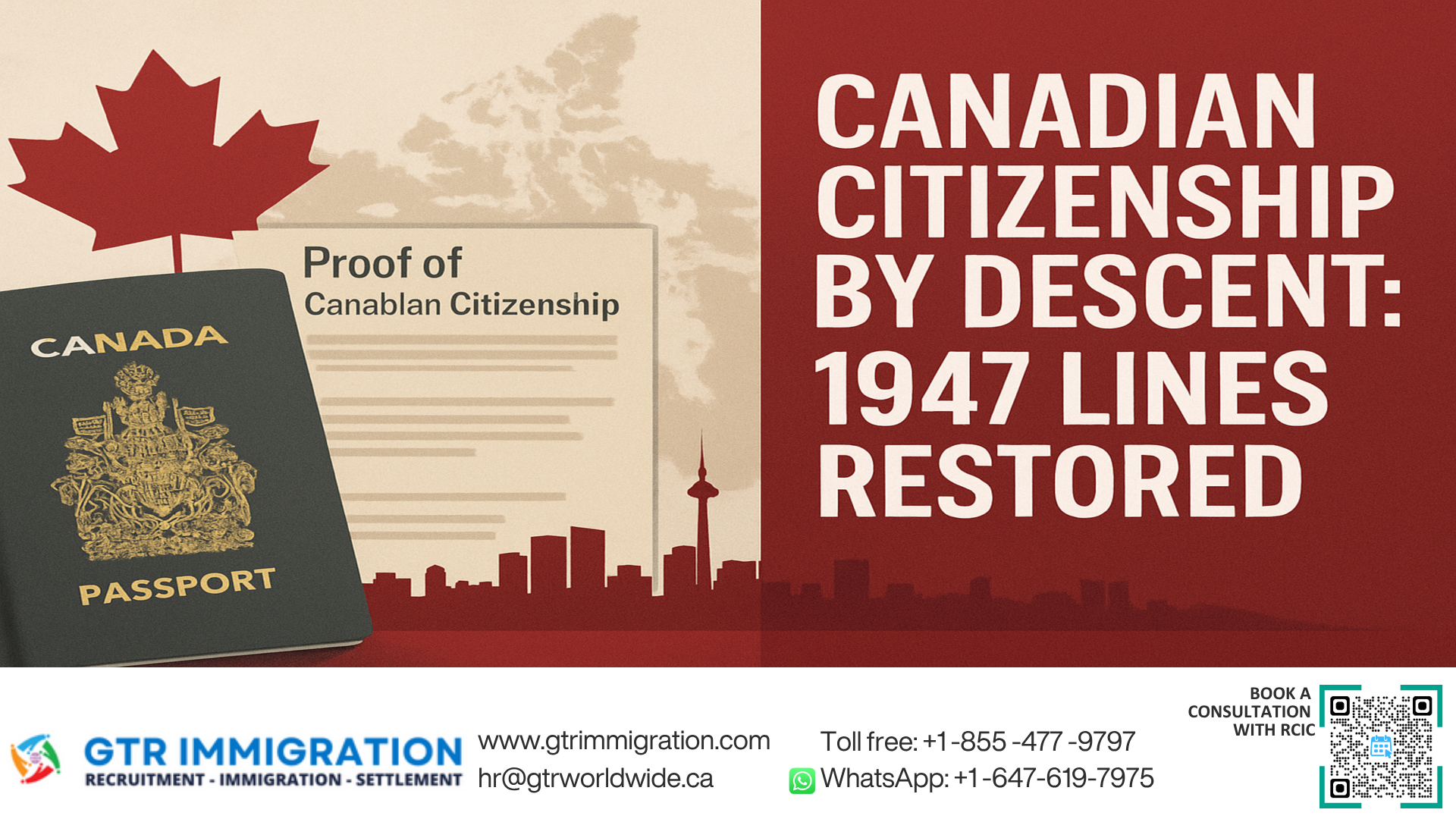
Canadian citizenship by descent and Bill C-3: reopening claims linked to ancestors alive before 1947
Why this matters now
On December 15, 2025, Bill C-3 came into force and removed a long-standing barrier that often prevented citizenship from passing beyond the first generation born abroad. If your family line includes an ancestor who lived in Canada before January 1, 1947 — or in Newfoundland and Labrador before April 1, 1949 — this change can reopen paths to citizenship by descent.
Why January 1, 1947 still matters
Canada only created citizenship as a separate legal status on January 1, 1947. Before then people in Canada were British subjects. The 1947 law applied narrow conversion rules, so some who were born, raised, or long resident in Canada did not become citizens automatically. Two features of those rules are especially important today: descent rules that treated fathers and mothers differently (and distinguished children born in and out of wedlock), and a rule that a married woman’s nationality followed her husband’s.
How those older rules cut family lines
Common patterns that point to an affected claim:
– A Canadian-born woman who married a non-Canadian before 1947 and lost her British-subject status, breaking descent to her children.
– An ancestor born or naturalized in Canada who emigrated before 1947 and therefore did not meet the conditions to convert to citizenship on January 1, 1947.
– A British subject who was ordinarily resident in Canada on the key date but did not satisfy the specific conversion conditions.
What Bill C-3 changed
Bill C-3 (Royal Assent November 20, 2025; in force December 15, 2025) removed the “first generation born abroad” barrier for people born outside Canada before December 15, 2025. Practically, this lets a parent — whose own status depends on corrected pre-1947 (or pre-1949 for Newfoundland) rules — be treated as a citizen for the purpose of passing citizenship to a child born abroad. If a grandparent or great-grandparent can now be recognized as a Canadian under the amended Act, that recognition can flow down the line, subject to the formal IRCC application process for a certificate of citizenship.
Newfoundland and Labrador: a separate date
Newfoundland and Labrador joined Canada in 1949, so claims tied to that jurisdiction use April 1, 1949 as the relevant date. The Act provides parallel categories for people born, naturalized, or ordinarily resident there on that date, and for people born abroad to qualifying Newfoundland parents.
Documentary proof IRCC will expect
IRCC updated its guidance on acceptable proof of lineage. Typical documents you’ll need include:
– Long-form birth certificates showing the parent-child link.
– Marriage certificates and other documents proving parentage across generations.
– Evidence of the ancestor’s status: British naturalization certificates issued in Canada or Newfoundland, proof of British-subject status, or equivalent historic records.
– Proof of residence in Canada before January 1, 1947 (or before April 1, 1949 for Newfoundland) when the claim relies on residence-based conversion.
– For women who lost nationality by marriage: the marriage certificate and proof of the husband’s nationality at the time.
Who is most likely to benefit
– Descendants of Canadian-born people who emigrated before 1947 and did not meet the automatic conversion conditions.
– Descendants of Canadian-born women who lost British-subject status by marrying foreign nationals prior to 1947.
– Descendants of British subjects who were ordinarily resident on the key dates but did not become citizens under the original mechanics.
– Families with ancestral ties to Newfoundland and Labrador before April 1, 1949.
Common complications that can block a claim
– A formal renunciation of citizenship by an ancestor.
– A declaration of alienage or other legal act showing an ancestor gave up nationality.
– Missing, inconsistent, or hard-to-find records for key events.
– A deceased ancestor in the chain, which can make documentary proof more difficult.
Practical next steps
– Map the direct parentage chain from the ancestor who lived in Canada to you.
– Identify which date and statutory category apply: Jan 1, 1947 for Canada; Apr 1, 1949 for Newfoundland and Labrador.
– Gather original civil documents across generations (long-form birth and marriage certificates, naturalization/British documents, proof of residence).
– For affected women, get the marriage certificate and evidence of the husband’s nationality.
– Expect some scenarios to be paper-only and require original historical documents.
– Check IRCC’s current checklist closely when preparing your application.
What to expect when you apply
If your evidence shows that a parent or ancestor now qualifies as a Canadian under the amended Act, apply to IRCC for a certificate of citizenship. The certificate is the formal confirmation you need to demonstrate status and to apply for a passport. IRCC will assess each application against the Act’s requirements and may require additional verification.
Final practical note
Bill C-3 restores a legal route that reconnects many family lines severed by mid-20th-century nationality rules. For people with ancestors in Canada before January 1, 1947 — or in Newfoundland and Labrador before April 1, 1949 — the change can convert family memory into a legally recognized claim, provided the documentary chain and statutory requirements are met. The pathway is not automatic; it requires careful documentation and an IRCC application.
🚀 Start Your Canada Immigration, Jobs & Settlement Journey Today
Need help with Express Entry, PNP, LMIA, Work Permit, Study Permit, Visitor Visa, Family Sponsorship, Canada Jobs, Recruitment, or Settlement guidance?
📱 WhatsApp / Call: +1 647 619 7975 / + 1 639 560 3180
🌐 Website: www.gtrimmigration.com
💼 Canada Job Site: www.ciccanadajobs.com
📊 Job Analytics & Labour Market Insights: www.jobmaze.ca
🔗 LinkedIn: www.linkedin.com/in/manojcanada
📘 Facebook: https://www.facebook.com/gtrimmigrationcanada
▶️ YouTube: https://www.youtube.com/@GoWithGoswami
📸 Instagram: https://www.instagram.com/gtr_immigration
#CanadianCitizenship #CitizenshipByDescent #BillC3 #LostCanadians #ImmigrationLaw #IRCC #NewfoundlandLabrador