



Forced Surrender of Citizenship Certificates Could Violate Charter Rights
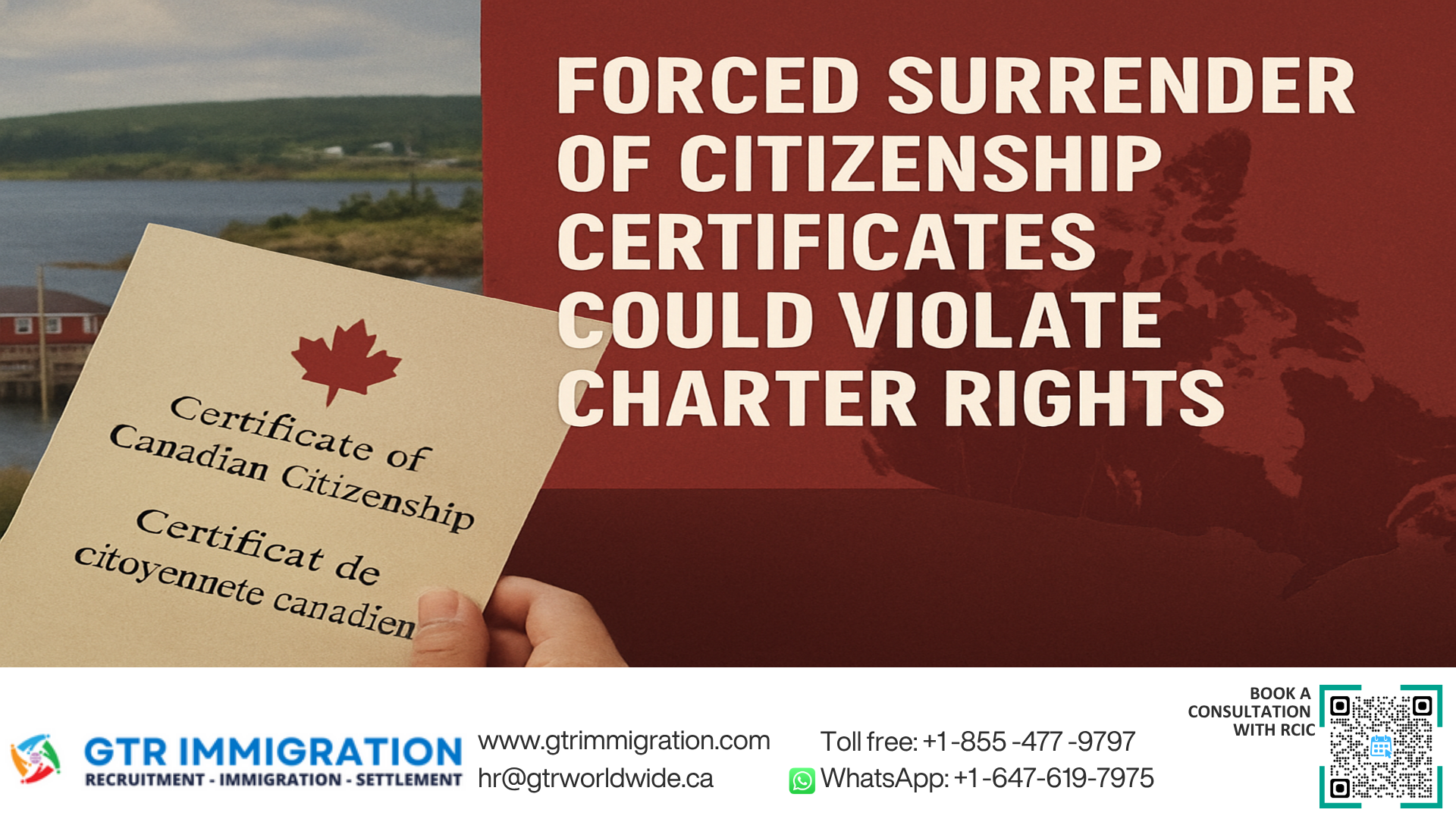
Registrar’s Mass Demand for Surrender of Proof of Canadian Citizenship: What Citizens by Descent Need to Know
The development and why it matters
On June 13, 2026, the Registrar of Citizenship sent letters en masse to people born outside Canada, requiring them to surrender their Canadian citizenship certificates immediately while investigations proceed. The Registrar relied on Citizenship Regulations 26(1), which permits surrender where there is reason to believe a person “may not be entitled to the certificate.” For holders of federal citizenship certificates who were born abroad, this affects their practical ability to prove and exercise citizenship rights even though, in law, they remain Canadian unless a different legal finding is made.
What the regulation authorizes and how it was used
Citizenship Regulations 26(1) allows the Registrar to demand the return of citizenship certificates (including certificates of citizenship and naturalization) if there is reason to believe the holder is not entitled to the document or has breached the Act. On June 13, 2026, the Registrar invoked this provision to issue written, immediate demands to people born abroad.
Key points:
– The demand is written and requires recipients to comply “forthwith.”
– It covers certificates that include a photograph and other federal citizenship documents issued under the Act or prior legislation.
– According to the source, this mechanism was applied to people born outside Canada and has not been used to seize provincial/territorial birth certificates from those born in Canada.
The constitutional question the letters raise
The mass surrender notice has prompted constitutional concerns. Canadian immigration lawyer Ala Bujac told CIC News on June 17, 2026 that the regulation, as applied, “appears to threaten all the citizenship rights of every Canadian citizen who was not born on Canadian soil” and that “there is a possible challenge” under the Canadian Charter of Rights and Freedoms.
Two Charter provisions are central:
– Charter 15(1) guarantees equality and prohibits discrimination, including on the basis of “national or ethnic origin.” A surrender process targeted at those born abroad could be argued to disadvantage citizens by descent.
– Charter 1 allows reasonable limits on Charter rights if they can be demonstrably justified in a free and democratic society. If a court finds an equality breach, the government would need to justify the limitation under Charter 1.
A potential challenge would therefore ask whether the regulation’s application discriminates against citizens by descent and whether any such infringement is justified.
Why a legal challenge could take years
Charter litigation typically involves multiple stages (applications, evidence, hearings, appeals) and can take years to reach a final determination. The source notes that affected rights holders should expect a lengthy process if a constitutional challenge is launched.
Who is directly affected
Those directly affected are holders of federal citizenship certificates who were born outside Canada—commonly citizens by descent—such as people who obtained a certificate because they were born to a Canadian parent abroad or registered under prior legislation.
Important distinctions:
– People born in Canada use provincial or territorial birth certificates to prove citizenship; those documents are not covered by 26(1) and were not part of the Registrar’s demand, per the source.
– Surrendering a certificate does not automatically strip legal citizenship under the Citizenship Act; it removes the primary federal proof of that status for many holders.
Practical realities: how a surrendered certificate can affect daily life
A citizenship certificate is standard federal proof of Canadian citizenship for many born abroad. While surrender does not necessarily change legal status, it can create immediate practical obstacles:
– Without the certificate, individuals may lack the federal proof many institutions expect when confirming citizenship.
– The source explains that citizens by descent “retain their rights as a Canadian citizen under law, but cannot equally exercise their rights in practice, given that they lack the document which proves their Canadian citizenship.” That practical inequality is central to the legal concern.
– Those born in Canada generally retain a birth certificate, which is not subject to the Registrar’s surrender power, creating an asymmetry in practical access to proof.
Why the targeted use of 26(1) raises equality concerns
Because the June 13 letters appear directed at people born abroad, two classes of citizens may be created in practice: those born in Canada who retain birth certificates and those born abroad whose federal proof may be seized. A court would likely consider:
– Whether the regulation’s application imposes a disadvantage linked to national or ethnic origin or place of birth;
– Whether that disadvantage is substantive — i.e., it meaningfully interferes with the ability to exercise rights; and
– Whether the government can justify the difference under Charter 1 as a proportionate and reasonable limit.
What affected individuals should watch for now
Affected persons and families should pay attention to:
– Any correspondence from the Registrar: preserve originals and copies.
– Deadlines and compliance language: how “forthwith” is interpreted will be important.
– Whether the Registrar provides the factual basis for the “reason to believe” in each case.
– Opportunities to contest the demand: seek legal advice promptly to understand procedural options.
– The broader enforcement pattern: mass issuance of letters may be relevant to claims about discriminatory effect.
Limitations of the current information
The source sets out the June 13 letters, cites 26(1), and reports legal concerns. It does not specify:
– How many letters were sent or which cohorts were targeted;
– The precise factual basis relied on in individual cases;
– Whether recipients were given an opportunity to be heard before surrender was demanded; or
– Any government public statement explaining the rationale beyond citing the regulation.
How courts may approach the constitutional analysis
A court would likely first consider whether the regulation’s application creates a distinction tied to a protected ground and whether it results in substantive inequality. If a breach of equality is found, the government would need to justify the limitation under Charter 1 through a proportionality analysis (pressing objective, rational connection, minimal impairment, proportionality of effects). The source notes that resolution of these issues would depend on factual records and could take considerable time.
What to look for next
Watch for:
– Public statements or policy clarifications from Citizenship and Immigration Canada or the Registrar;
– Legal challenges or test cases that clarify arguments and timelines;
– Administrative guidance on how recipients can respond or obtain temporary documentation; and
– Reporting from immigration lawyers representing affected clients.
Practical reminders for holders of citizenship certificates
Based on the facts reported:
– Preserve the original correspondence and copies of identity and citizenship documents.
– Note deadlines in the demand and get legal advice quickly.
– Do not destroy other identity documents; keep records of all communications with federal officials.
– Monitor legal developments and public announcements related to the June 13 action.
Final perspective
The Registrar’s June 13, 2026 letters relying on Citizenship Regulations 26(1) have raised a structural issue: a regulation that enables forced surrender of federal citizenship certificates for people born abroad, while leaving birth certificates of those born in Canada unaffected, creates a tension between legal status and practical ability to prove citizenship. A plausible Charter 15(1) equality claim exists; resolving it will likely require litigation and time. In the meantime, recipients should keep careful records and seek professional advice.
🚀 Start Your Canada Immigration, Jobs & Settlement Journey Today
Need help with Express Entry, PNP, LMIA, Work Permit, Study Permit, Visitor Visa, Family Sponsorship, Canada Jobs, Recruitment, or Settlement guidance?
📱 WhatsApp / Call: +1 647 619 7975 / + 1 639 560 3180
🌐 Website: www.gtrimmigration.com
💼 Canada Job Site: www.ciccanadajobs.com
📊 Job Analytics & Labour Market Insights: www.jobmaze.ca
🔗 LinkedIn: www.linkedin.com/in/manojcanada
📘 Facebook: https://www.facebook.com/gtrimmigrationcanada
▶️ YouTube: https://www.youtube.com/@GoWithGoswami
📸 Instagram: https://www.instagram.com/gtr_immigration
#CanadianCitizenship #CitizenshipRegulations #CharterRights #ImmigrationLaw #CitizensByDescent #CanadaImmigration #LegalUpdate