



Top 5 U.S. States Eligible for Canadian Passport by Ancestry
Canada citizenship by descent update: who in New England may now qualify
Why Canada’s December 15, 2025 change matters for many Americans
On December 15, 2025 Canada removed the “first-generation” limit on citizenship by descent. That legal change means millions of people worldwide — including a large number of Americans with Canadian ancestors — can now apply to confirm Canadian citizenship through descent and, after receiving proof, apply for a Canadian passport. For residents of New England states that historically received large waves of migration from Quebec, the update could turn family lore and French-sounding surnames into a tangible right: the ability to hold dual U.S.–Canadian citizenship.
How a nineteenth-century migration still shapes eligibility today
The roots of this development reach back to a mass movement known as the “Great Hemorrhage.” Between about 1840 and 1930 close to one million French Canadians left Quebec for jobs and new communities in the Northeastern United States. These migrants settled in mill towns and cities where labor was in demand. For example, Manchester, New Hampshire hosted around 23,000 French-Canadians by 1910 — roughly 38% of the city’s population at that time. Lewiston, Maine’s Franco-American neighbourhoods and Woonsocket, Rhode Island — described historically as one of the most French cities in the U.S. — also retain that legacy. Massachusetts accumulated a large Franco-American population as well: by 1990 the state counted an estimated 310,636 Franco-Americans, nearly half of New England’s total.
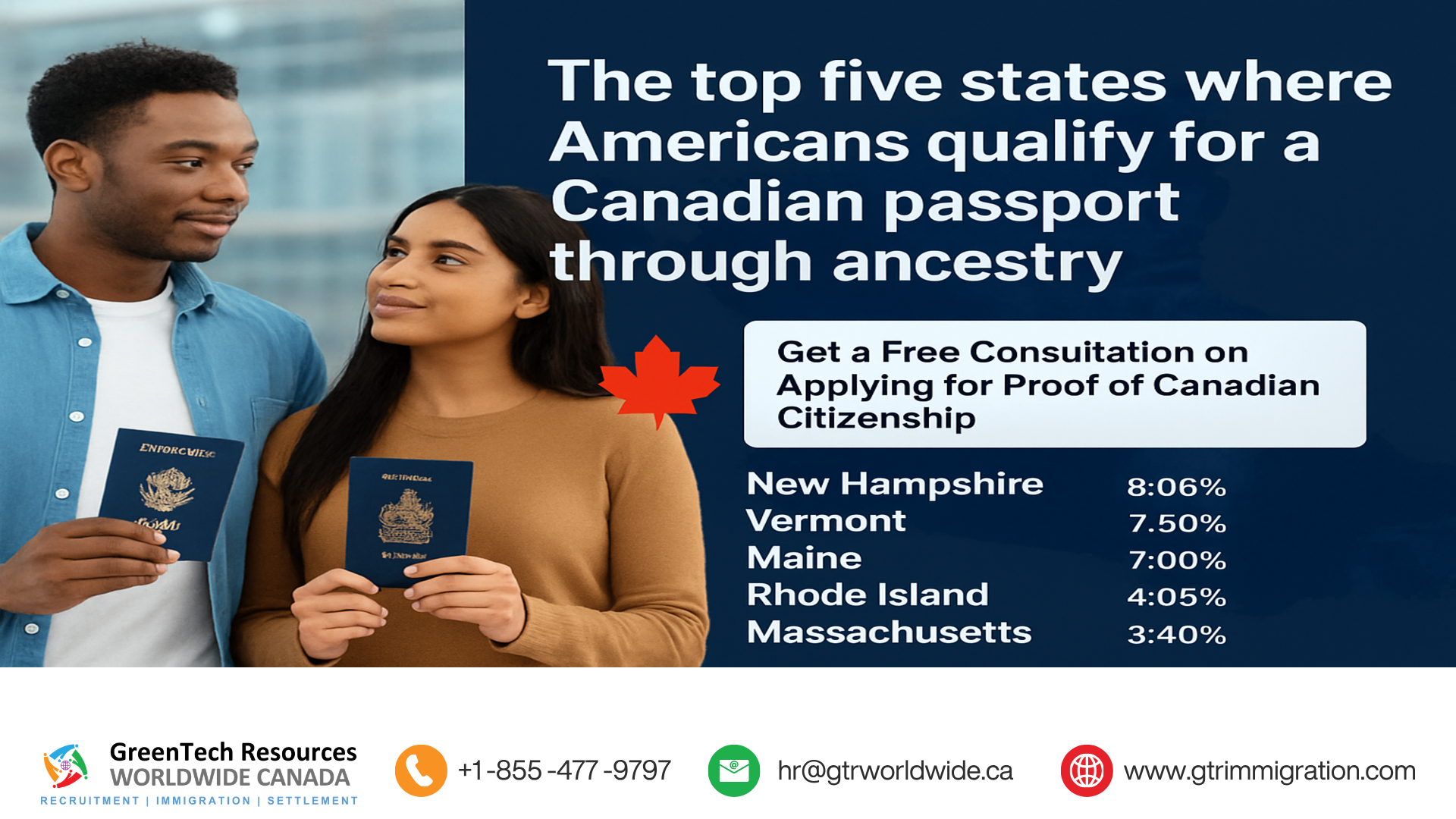
That historical movement explains why certain New England states today report higher shares of residents with Canadian-born ancestry. U.S. Census Bureau self-reported figures for 2024 show:
- New Hampshire: 8.06%
- Vermont: 7.59%
- Maine: 7.00%
- Rhode Island: 4.05%
- Massachusetts: 3.40%
The source content notes that the real number of people with Canadian ancestry in New England may be three to four times higher than self-reports, because many people are unaware of distant Canadian roots.
What the December 2025 change actually does
Before this change, Canadian citizenship by descent was generally limited to the first generation born abroad — meaning a Canadian-born parent could pass citizenship to children born outside Canada, but subsequent generations could lose that automatic right. Removing the first-generation limit opens the path for people with a chain of descent from a Canadian-born ancestor to claim citizenship, provided they can document the lineage.
Practically, the process requires two major steps:
- Apply for proof of Canadian citizenship (a certificate confirming the applicant is a Canadian citizen by descent).
- Use that certificate to apply for a Canadian passport.
According to the source content, applying for proof of citizenship means compiling official records (birth certificates, marriage certificates, death certificates) for each generational step between the applicant and the Canadian-born ancestor, and submitting the completed application to Immigration, Refugees and Citizenship Canada (IRCC). Processing time for proof of citizenship applications is reported as roughly one year; once the certificate is issued, a Canadian passport application usually takes between 10 and 20 business days.
Who is likely to be affected in New England
The change primarily affects people who can trace a continuous line of descent to a Canadian-born ancestor, whether that ancestor was born in Quebec or elsewhere in Canada. Based on historical migration patterns, this has particular relevance for families from New Hampshire, Vermont, Maine, Rhode Island and Massachusetts. The source content offers illustrative local data:
- New Hampshire — large Quebec migration into mill towns; census shows 8.06% self-report Canadian ancestry.
- Vermont — long shared border with Quebec; by 1860 more than 16,000 French Canadians were estimated to have settled in the state; 7.59% self-report Canadian ancestry in 2024.
- Maine — Lewiston had Franco-Americans representing nearly half the city by 1920; statewide self-reported Canadian ancestry is 7.00%.
- Rhode Island — Woonsocket was majority French-Canadian by 1900; statewide self-reported Canadian ancestry is 4.05%.
- Massachusetts — heavy Franco-American settlement historically; 3.40% self-report Canadian ancestry in 2024, with broader estimates suggesting more may be eligible.
The source points out that in some communities the share of residents with French-Canadian roots is much higher than statewide averages, so local genealogical resources will be important for many applicants.
Practical implications for U.S. residents considering a claim
For eligible Americans, confirmed Canadian citizenship brings a range of practical changes:
- Legal status: a Canadian citizenship certificate confirms the person is a Canadian citizen by descent and can be used to obtain a Canadian passport.
- Mobility and document backup: the passport provides the usual travel and identity benefits. The source notes many Americans are applying without plans to emigrate, using the passport as an additional travel or contingency document.
- Administrative workload: the most time-consuming part is assembling compliant proof for each generation — birth, marriage and death records linking the applicant to the Canadian-born ancestor.
The source specifies that gathering compliant official copies is often the labor-intensive step; applicants must ensure records meet IRCC’s documentary standards and cover every generational link.
Evidence and genealogical clues to pursue
Because the historical migration involved predominantly French Canadians, certain surname patterns and local family histories can help identify potential eligibility. The source notes that many French names were anglicized over time — examples provided include Charpentier becoming Carpenter, and Leblanc becoming White. Other practical research clues include:
- Local concentrations: towns with known historic Franco-American populations such as Manchester (NH), Lewiston (ME), and Woonsocket (RI) are places to search municipal, church and labour records.
- Genealogical societies: specialized collections exist. For example, the American-French Genealogical Society in Woonsocket holds a large collection of vital statistics and historical records focused on French-Canadian descent (the source mentions over 20,000 volumes).
While these clues are useful, the decisive factor for IRCC is traceable, official documentation for each link in the chain of descent.
Administrative timeline and expectations
The source provides a practical timeline estimate:
- Proof of Canadian citizenship application: processing time roughly one year.
- Canadian passport application after certificate issuance: typically 10–20 business days.
Applicants should plan for the time needed to locate and obtain certified copies of historic records, and for IRCC’s processing window once the application is submitted.
Who should consider applying — and who should be cautious
Good candidates to begin research and potential application are:
- Individuals with family stories, surnames, or local ties pointing to a Canadian-born ancestor.
- Residents of New England, especially in communities with known Franco-American heritage.
- Anyone who values an additional passport or dual citizenship as part of personal, professional or contingency planning.
Those who should proceed with careful preparation include applicants who:
- Have gaps in their family documentary chain: missing birth, marriage or death certificates are the main practical obstacle.
- Have anglicized surnames or uncertain place-of-birth records; these cases often require deeper local or parish-level searches.
The source stresses that continuity of documented descent is the legal requirement; without compliant records for each generation, IRCC cannot issue the certificate.
Next steps applicants should prioritize
Based on the procedures described in the source content, sensible next steps are:
- Start family research now: interview relatives, collect family documents, and note birthplaces and dates.
- Identify the Canadian-born ancestor and build a generation-by-generation list of required civil records (birth, marriage, death) linking you to that ancestor.
- Locate record holders: local city or town halls, provincial archives, churches, and specialized societies (for French-Canadian records) are common sources.
- Obtain certified, compliant copies: because IRCC requires official documents, plan for the time and potential fees to request and receive certified records from each jurisdiction in the chain.
- Prepare for processing time: expect roughly one year for citizenship proof processing, then the passport timeline of 10–20 business days once the certificate arrives.
Careful documentation and a methodical approach reduce the risk of a refused or delayed application.
Questions and common misunderstandings to watch for
Several points in the source content highlight common misunderstandings:
- Self-reported ancestry is not the same as legal citizenship: many people report Canadian ancestry, but only those who can prove a continuous line to a Canadian-born ancestor will qualify.
- Not all descendants will be eligible immediately: eligibility depends on documentary proof of descent; family lore alone is insufficient for IRCC.
- Applying for proof of citizenship is a prerequisite to a passport: the passport cannot be issued without the citizenship certificate first.
Applicants should avoid assuming automatic entitlement based solely on family stories or surname clues; documentation is decisive.
Local examples that illustrate the scale
The source highlights several local historical figures and community patterns that explain the potential scale of claims:
- Manchester, New Hampshire: roughly 23,000 French-Canadians by 1910, a substantial share of the city’s population at the time.
- Vermont: by 1860 an estimated 16,000 French Canadians had settled there — more than any other New England state at that point.
- Lewiston, Maine: Franco-Americans formed nearly half of the city’s population by 1920; “Little Canada” remains a local memory.
- Woonsocket, Rhode Island: recorded as 60% French-Canadian by 1900 and home to concentrated genealogical resources.
These historical concentrations help explain why states like New Hampshire and Vermont are highlighted as having strong potential eligibility pools after the citizenship law change.
For personalized support with your Canadian immigration pathway, contact GTR Immigration. Call us: +1 855 477 9797
#CanadianCitizenship #CitizenshipByDescent #DualCitizenship #NewEngland #Genealogy #IRCC #CanadianPassport